
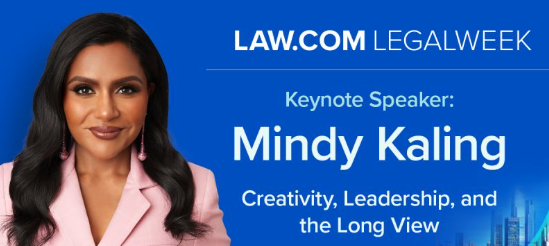
As talk of AI and automation abounded last week at ALM’s Legalweek, the writer, actor, and producer Mindy Kaling took the stage to share her wit and wisdom. She offered poignant insights about the role AI will play in professional work and the critical eye needed to identify talent in an increasingly performative world.
AI Will Replace Mediocrity
Kaling didn’t mince words when evaluating the impact of new tech tools, saying: “Mediocrity will 100% get replaced by AI.” But she also put that assessment into context.
AI can read and summarize every episode of The Office, but if you ask it to write a new episode, it won’t be funny. While AI can mimic patterns, it can’t supplant the high-level creativity and imagination required for great writing — at least not yet. Looking ahead, she noted that the dynamic could change as technology gets more sophisticated. For now, performers will continue trying to safeguard their roles from replacement.
Kaling also said she finds generative AI incredibly helpful for anything logistical. For example, every Christmas, she would have to write thank-you notes to all of her children’s teachers and the security guards at school. Multiply that by three kids, and you have a lot of thank-yous to draft. She admitted that she doesn’t write those anymore. They don’t require artful creativity, so AI can draft them at scale.
For output that is basic, rote, or logistical, AI is an excellent tool to increase productivity. But it excels at mediocrity. Just as in legal tech, the low-level tasks can be automated but not the nuance of high-level judgment.
Technology Widens Access
Kaling also noted how technology has provided wider availability of information and access, which offers new entry points for upcoming professionals. She depicted that shift with a memorable anecdote.
As a 15-year-old growing up in Boston, she was obsessed with Saturday Night Live. Foreshadowing her prolific career in comedy, Kaling looked up the address for Lorne Michaels’ entertainment company (in the phone book!) and mailed him a pile of scripts she’d drafted based on sketches with stars like Adam Sandler and David Spade.
The envelope was eventually returned, unopened. Kaling felt devastated.
At that time, she had no access to the world of entertainment and no knowledge of the process. Contrast that with now, when social media provides a widely available platform for comedians and writers to talk about their process and share their experiences, which provides inspiration and a reference point for the next generation.
Find Talent Beyond the Extroverts
While social media provides an outlet for aspiring entertainers, the algorithms don’t result in a meritocracy. In fact, an incentive structure that rewards performativity and engagement can act as a barrier.
As Kaling cautioned, “extroverted does not equal talented.” As someone who was raised by “quiet, studious immigrants,” she advised that the best people she’d worked with, those who were the most generous and the best mentors, aren’t the ones with a desire to get a ring light and post multiple times a day on TikTok.
Kaling said she wished it was easier for someone in her position to find those people who are deeply funny but not the most camera-ready or extroverted.
That shaped her advice for identifying talent, which applies to people across all industries. It’s critical to remain open to different skill sets and look in different places. You may have to work a bit harder to find it, but it helps to build a diverse team of standout performers.
Bring Receipts
Although her character from The Office, Kelly Kapoor, does not reflect her personality — which is apparently a common misconception — Kaling did say Kapoor is the most lawyer-like of all the roles she’s played because “she brought receipts, like every good lawyer needs to do.”
Kaling’s insights also reminded the audience that while technology can replace mediocrity, and it’s growing more sophisticated, it still cannot replace judgment. In an era of AI and transformation, leaders should put in the extra time and effort to look beyond performative work when seeking the best talent.