
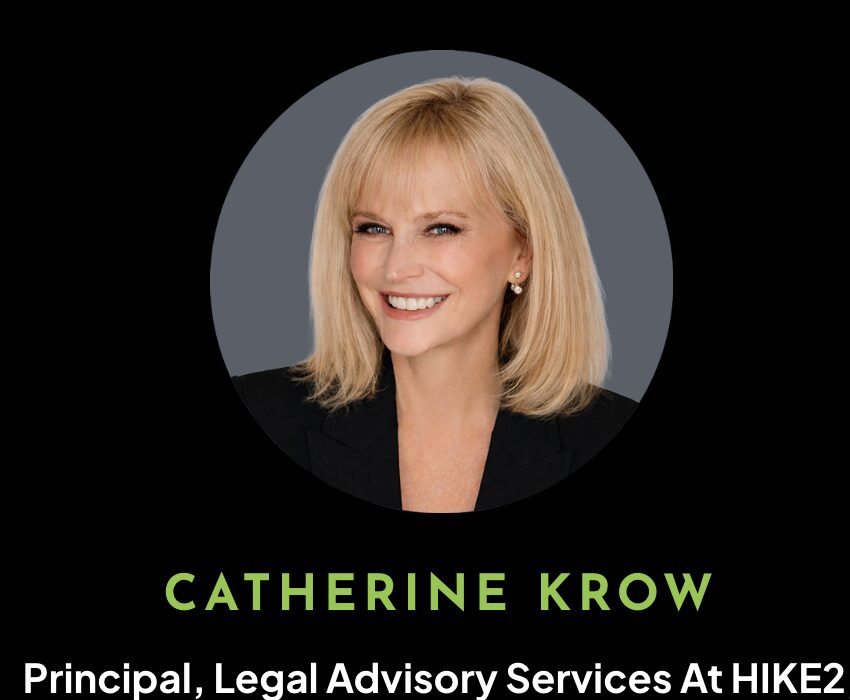
An Interview with LIMELIGHT Advisory Board Member Catherine Krow
Welcome back to LIMELIGHT’s Spotlight Series, where we sit down with the brilliant members of LIMELIGHT’s Advisory Board to get their insights on the challenges facing the professional services landscape, from corporate growth and marketing to the increasing presence of AI across industries.
For our second entry to the series, we spoke with Catherine Krow, Principal of Legal Advisory Services at HIKE2 and Former Founder and CEO of Digitory Legal. Informed by nearly two decades of experience as a trial attorney across elite firms including Orrick, Herrington & Sutcliffe and Simpson Thacher & Bartlett, Catherine is one of legal tech’s most recognized innovators, helping law firms and legal departments navigate the successful adoption and integration of AI. Below, she discusses what drew her to LIMELIGHT, the value of profile and presence before the pitch, and the critical importance of data discipline.
The Conversation
LIMELIGHT: To start, could you briefly describe your current role at HIKE2 and what you focus on day-to-day?
Catherine Krow: I’m excited to share that I have recently joined HIKE2 as Principal of Legal Advisory Services. HIKE2 is a strategic transformation consultancy that works at the intersection of AI, data, governance, and change management. They work exclusively in highly regulated industries — including law firms and legal departments, which is where I live. My focus is helping firms move from AI curiosity to successful AI execution and scale. That means diagnosing where data foundations are broken, building the change management infrastructure to make transformation stick, and helping leadership translate what the technology can do into something clients actually trust and pay for.
I came to this work through practice: 17 years as a litigator, then founding Digitory (an AI-powered platform for legal financial analytics) which was later acquired by BigHand. I’ve sat on many sides of the legal industry: as a lawyer who needed better tools, as a founder building them, and as a business leader scaling them. That macro perspective is what I bring to clients at HIKE2.
LIMELIGHT: What drew you to join LIMELIGHT’s Advisory Board?
Catherine Krow: I’ve admired LIMELIGHT for a while now, because of how much value they provide to professional services firms. Most professional services firms are either invisible in the key moments that matter (like when a potential client is doing due diligence) or visible for the wrong reasons (like publicizing generic content or recycled positioning). I’ve seen how LIMELIGHT is helping to correct for this, and it is important work.
I’ve navigated this personally. When I was building Digitory, I had to figure out how to make people believe in a vision before the product was fully built. I know that the LIMELIGHT approach — strategic, differentiated, built around real expertise — is a proven pathway towards a real breakthrough. I’m thrilled to be a part of a company that is doing this work.
LIMELIGHT: From your perspective, what is changing most quickly in how professional services firms grow and compete today?
Catherine Krow: The buying process has shifted. Clients are forming views about your firm long before anyone picks up the phone. They’re reading what your partners have written, watching how your firm talks about hard problems, running your name through AI tools that synthesize reputation in seconds.
By the time you’re in a pitch, you’ve either already won some credibility or you’re starting from zero. That’s new. The old model — relationships, referrals, a good dinner — still matters, but it’s no longer sufficient on its own. The firms that are growing right now have figured out how to earn attention before the conversation starts.
LIMELIGHT: What are firms still getting wrong when it comes to marketing, communications and business development?
Catherine Krow: They’re leading with credentials instead of insight. “We have great lawyers.” “We’ve handled complex matters.” Those are table stakes.
What clients want to know is: do you understand my business? Do you see problems I haven’t seen yet? Can I hand you something complicated and trust you to handle it? The firms that answer those questions — in their content, their proposals, their client conversations — are the ones that will thrive.
The other thing firms get wrong is treating business development as a marketing function instead of a firm-wide discipline. Business development happens in every client conversation, every thought leadership piece, every panel appearance. It needs to be embedded in the culture.
LIMELIGHT: In what ways has AI changed how firms are discovered and evaluated by potential clients?
Catherine Krow: Search is changing. When a GC or a CFO or a procurement team types a question into an AI tool, what comes back isn’t a ranked list of websites. It’s a synthesized answer — and that answer draws on what your firm has put into the world. Your publications, your people’s thought leadership, your public track record. If you haven’t built that foundation, you don’t become part of that answer.
There’s also a deeper trust dynamic shifting. Clients used to evaluate firms primarily through relationships and referrals. Now they have much more data. They can see what your partners have written, what panels they’ve been on, how they talk about problems. The bar for demonstrating expertise has gone up significantly.
LIMELIGHT: Where do you see the biggest opportunity for firms as they navigate this shift?
Catherine Krow: Differentiation. The legal industry is notoriously resistant to it — everyone says they’re client-focused, innovative, and collaborative. But the firms that can demonstrate expertise in a specific problem with specific data and specific insight? That’s where the real competitive advantage is.
I’ve watched this play out in legal pricing. For years, “it depends” was the answer to every cost question. The firms that got serious about data — that could actually say here’s what this type of matter costs, here’s why, here’s our track record — started winning pitches they weren’t winning before. That same dynamic is playing out now in AI. The firms that can show, not just tell, what they’re doing differently? They’re going to pull ahead fast.
LIMELIGHT: When it comes to visibility, where should firms be investing their time?
Catherine Krow: While LinkedIn is still important, I would push firms to think beyond posting and towards presence — being in the rooms where decisions are being shaped and the clients are speaking. That means panels, podcasts, client advisory boards, trade shows, industry working groups. The content you create from those moments has real gravitas.
In addition, the research done by LIMELIGHT and JD Supra shows that clients are less focused on LinkedIn than on news and industry publications. To make content count, that’s where it needs to be published.
LIMELIGHT: What separates thought leadership that actually drives business from content that gets ignored?
Catherine Krow: Point of view. Most legal content is a summary — here’s what the regulation says, here’s what the statute changed. That’s not what I think of as thought leadership. To me, real thought leadership takes a position. It says: here’s what everyone else is missing, here’s why I think that, here’s what you should do about it; it helps people think differently about hard problems.
The other separator is specificity. Vague observations about “the changing legal landscape” have become background noise. Concrete data, concrete examples, a specific framework — that’s a differentiator.
LIMELIGHT: What is one decision you’ve made or shift you’ve seen that had the biggest impact on growth?
Catherine Krow: Getting serious about data before I needed it. When I built Digitory, I was solving a pricing and cost management problem. But because we’d built the data infrastructure correctly — cleaning timecard data, classifying work at the task level — we were able to see patterns nobody else was seeing. That’s when we realized the same data that drives profitability also reveals equity and talent retention issues. It completely changed the market we could serve and the conversations we could have.
The lesson: build your foundation when the pressure is low. Don’t wait for the CFO to ask a question you can’t answer to start getting your data right.
LIMELIGHT: What is your advice to leaders trying to navigate this current environment?
Catherine Krow: Don’t wait for certainty. The firms and leaders I’ve watched fall behind in the last decade all had the same move: they wanted to see someone else prove ROI first. They kept their heads down, waited for the market to stabilize, and looked for consensus before committing. That’s not strategic and it won’t work anymore.
The change is coming regardless. The question is whether you’re building the foundation now or scrambling to catch up in two years. Get your data in order. Get your people equipped. Start creating the track record that will make you credible in whatever comes next.
LIMELIGHT: Looking forward, what are you paying the closest attention to over the next 12 to 18 months?
Catherine Krow: The gap between AI adoption and AI ROI. Firms are buying tools. A lot of them. But most can’t yet prove what they’re getting out of it — because their data foundations aren’t ready, their people aren’t equipped, and they haven’t thought through what “better” actually looks like. That gap is going to create real pressure. This is part of the reason I’m so excited to join HIKE2. We are actively solving these problems for professional services firms. Tools can be great but a tool alone is not enough. Many firms need a strategic partner to help guide them through these changing times.
I’m also watching the pricing conversation closely. We’re moving toward outcome-based models — clients want to pay for results, not hours. That requires data. It requires a completely different kind of commercial conversation than most lawyers are trained to have. The firms that figure that out first will have an enormous advantage.
LIMELIGHT: Finally, what do you see as the biggest differentiator for the firms that win this next phase?
Catherine Krow: Two things. First: data discipline. Not AI for its own sake — AI is only as good as the data you feed it. The firms that have invested in clean, structured, usable data will move faster and smarter than everyone else. Garbage in, garbage out. That hasn’t changed.
Second: change leadership. Technology is the easy part. Getting people to actually use it, getting partners to change behavior that has worked for decades, building a culture that can absorb continuous transformation — that’s the hard part. The firms that treat change management as a real capability, not an afterthought, will sustain gains in this evolving market.
This is the second interview in our multi-part LIMELIGHT Advisory Board Series. In the coming weeks, we will continue to share perspectives from leading executives on how modern firms can grow their business, refine their profile, and prepare for the next wave of industry transformation.