

Why AI Tools Alone Won’t Save Law Firm Marketing—and What Will
By, Kenny Gary
When Anthropic released Claude Cowork, the reaction across marketing, legal, and professional services teams was immediate and visceral. This wasn’t just another model update. It wasn’t incremental speed or slightly better writing. It was a signal that AI is evolving from a task-based assistant into a persistent, collaborative participant in how work actually gets done.
For law firms and professional services organizations, this marked an inflection point. AI is no longer something marketing teams “use.” It is becoming something they must design around, govern, and lead.
And that changes everything.
From Tools to Teammates—and a New Category of Risk
Up until recently, most AI platforms lived on the margins of marketing workflows. Draft a blog. Clean up an alert. Rewrite a paragraph. Useful, but contained. The release of Claude Cowork reframed the conversation entirely by showing what happens when AI is embedded into ongoing collaboration, document iteration, and shared workspaces.
For professional services firms, this is both exciting and unsettling. The opportunity is speed and leverage. The risk is diffusion of accountability. When AI participates in the workstream itself, the question is no longer “Is this accurate?” but “Who is ultimately responsible for strategy, voice, and judgment?”
That question cannot be answered by software.
Claude and the Rise of the AI Collaborator
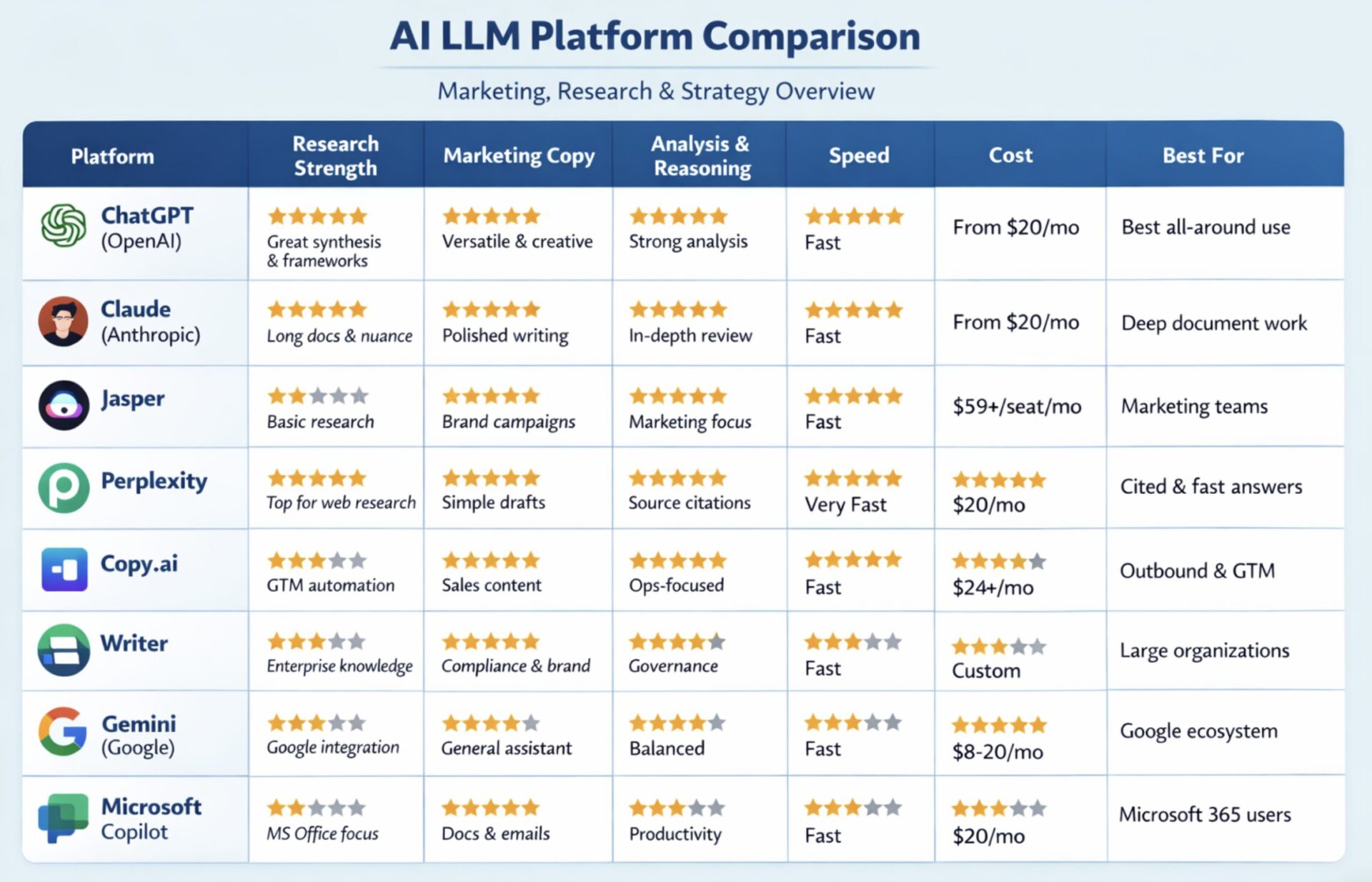
Claude has long been favored by law firm marketers for its restraint, clarity, and ability to handle long, complex documents. Cowork took that a step further by making it clear that AI is now capable of sitting inside collaborative processes rather than operating as a one-off editor.
This is a powerful shift. It means AI can help teams track thinking, refine drafts over time, and maintain context across evolving projects. But it also means AI will reflect—and reinforce—whatever strategy already exists. If that strategy is vague, internally conflicted, or poorly articulated, AI doesn’t correct it. It accelerates it.
Claude Cowork didn’t make humans less important. It made editorial leadership and strategic direction non-negotiable.
ChatGPT and the Amplification Effect
ChatGPT remains the most flexible and powerful generalist in the market, especially for professional services marketers who are asked to think strategically, move quickly, and cover a wide range of formats. It is excellent at synthesizing ideas, turning raw attorney input into narratives, and helping senior marketers pressure-test positioning.
But ChatGPT also reveals a hard truth: AI cannot fix unclear thinking. If a firm lacks a strong point of view, differentiated positioning, or disciplined messaging strategy, ChatGPT will simply produce more articulate versions of that ambiguity.
In other words, AI doesn’t create strategy—it amplifies whatever strategy is already there, good or bad. This is why firms with senior marketing leadership see exponential gains from AI, while others see chaos disguised as productivity.
Perplexity and the Credibility Arms Race
Perplexity’s rise underscores another shift accelerated by Claude Cowork: research and credibility are no longer optional. In a world where content is cheap and abundant, what differentiates thought leadership is defensibility. Sources matter. Accuracy matters. Context matters.
Perplexity excels at surfacing verifiable information quickly, which is invaluable for law firms producing reports, market analyses, and POVs. But research alone does not equal relevance. Deciding what to include, what to exclude, and how to interpret findings still requires human judgment grounded in business goals and audience insight.
AI can gather facts. It cannot decide what those facts should mean for your firm’s growth strategy.
Jasper and the Industrialization of Content
Jasper represents another evolution: the industrialization of marketing production. For firms with large in-house teams and mature governance structures, Jasper can enforce consistency, manage workflows, and reduce risk. It is optimized for scale.
But scale without strategy is a liability. Jasper does not determine positioning, challenge assumptions, or resolve internal misalignment. It assumes those questions have already been answered. In professional services, they often haven’t.
Claude Cowork made clear that production efficiency is no longer the bottleneck. Strategic coherence is.
The Real Shift: From “Using AI” to Designing AI Workflows
The biggest misconception in law firm marketing right now is that success comes from choosing the “right” AI tool. In reality, success comes from designing the right operating model around those tools.
Claude Cowork crystallized this truth. As AI moves closer to the center of collaboration, firms must decide how strategy flows into execution, how judgment is applied, and where accountability ultimately lives. Without that clarity, AI becomes a fragmentation engine rather than a growth engine.
This is not a technology problem. It is a leadership problem.
Why Strategic Oversight Is Now the Differentiator
Even the most advanced AI platforms cannot define competitive advantage, manage internal politics, or protect a firm’s reputation through restraint. Those responsibilities sit squarely with experienced marketing leaders and trusted advisors who understand the legal industry’s nuances.
AI can draft. AI can research. AI can collaborate. But only humans can decide what a firm should stand for, what risks are acceptable, and what stories are worth telling. The more powerful AI becomes, the more essential that human layer is.
Claude Cowork didn’t eliminate the need for counsel. It raised the cost of operating without it.
LIMELIGHT’s POV
LIMELIGHT sits at this intersection every day. The intense pressure of raising digital authority has never before been so tatamount. Each of these LLMs crawl and deliver data– categorizing third party credible and trusted sources most.
That’s where we live. Generative Engine Optimization (“GEO”) also referred to as Answer Engine Optimization (AEO) fuel so much of we do and how we operate today. To disregard the importance – well, that’s just not an option and that’s one of the big reasons why we started LIMELIGHT.
Our role isn’t to sell tools. It’s to help professional services companies, law firms, and the technology companies that fuel them to design strategic, governed, AI-enabled go-to-market workflows that scale visibility without sacrificing credibility. We help growing companies and law firms decide how AI fits into positioning, content strategy, and growth—not the other way around.
AI doesn’t need supervision because it’s dangerous; it needs supervision because it’s incredibly powerful.
Final Thought
Claude Cowork marked the moment AI stopped being a sidekick and started becoming a participant. For law firms and professional services organizations, that’s the line between experimentation and transformation.
The firms that win won’t be the ones with the most advanced tools, they’ll be the ones with the clearest strategy and the strongest counsel guiding how those tools are used.