
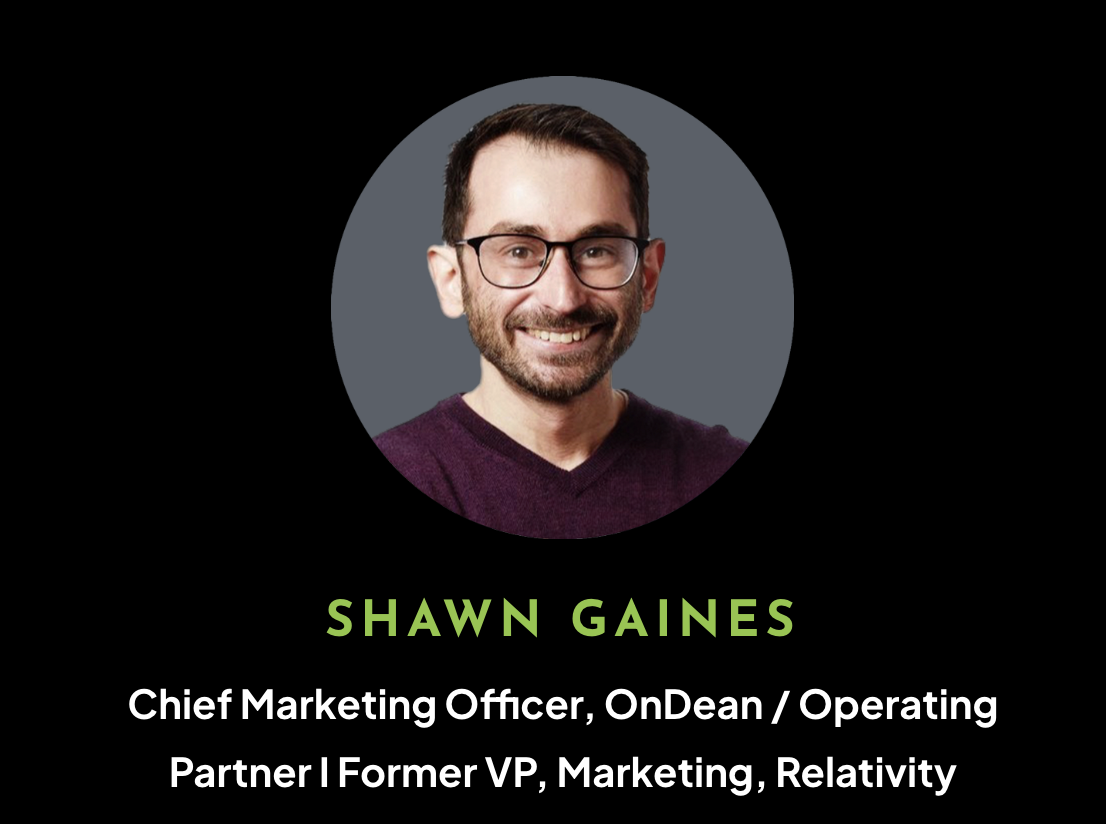
An Interview with LIMELIGHT Advisory Board Member Shawn Gaines
Welcome back to LIMELIGHT’s Spotlight Series, where we sit down with the brilliant members of LIMELIGHT’s Advisory Board to get their insights on the challenges facing the professional services landscape, from corporate growth and marketing to the increasing presence of AI across industries.
In our next spotlight in this series, we sat down with Shawn Gaines, Chief Marketing Officer at OnDean, a platform that spans legal technology investing, philanthropy, and professional motorsports. Previously, Shawn spent nearly 10 years at Relativity, helping grow the marketing team from three to 90+ employees. But his path to OnDean wasn’t direct from Relativity. After Relativity, he was CMO at HR tech startup Able, then most recently CMO at hospitality tech company Sertifi before it was acquired by Flywire in early 2025.
In our conversation, Shawn shares his perspective on how AI is reshaping the way professional services firms operate; not just the tools they use, but how teams learn, adapt, and stay focused on customers. He also reflects on the enduring value of authenticity, focus, and human connection in a landscape that’s changing faster than ever.
THE CONVERSATION
Can you briefly describe your current role and what you focus on day to day?
I have one of those jobs that’s a little hard to explain, which is probably why I enjoy it so much.
On paper, legal tech investing, philanthropy, and professional motorsports don’t seem to have much in common. In practice, they’re all about building organizations, understanding people, and figuring out how to grow something meaningful.
The legal tech side is probably most relevant here. Through OnDean Forward, our investment fund, I work with a small group of legal tech companies as more of an operating partner than a traditional investor. Sometimes that means helping a founder think through positioning. Other times it’s building out a marketing function, helping with a launch, or just being another set of eyes on a marketing asset.
No two days are the same. I might spend the morning talking about go-to-market strategy with a startup, the afternoon working on sponsorships for OrangeCat Racing, and end the day thinking about messaging for our philanthropy work at Alta Futures.
What drew you to join Limelight’s Advisory Board?
I’ve spent a good chunk of my career in legal tech. I was at Relativity for almost 10 years, left for a while to work with two other startups, and now I’m back in the space through OnDean Forward.
For me, joining LIMELIGHT’s advisory board was a way to get back into that space alongside some brilliant leaders in legal. The legal market is changing quickly, and I’m excited to hear what other people are seeing. That helps me, it helps our portfolio companies, and hopefully I can contribute something useful in return.
Second, I’ve known Erin and Kenny for a long time. I’ve always respected how they approach the industry, so when they asked me to join, it wasn’t a difficult decision.
From your perspective, what is changing most quickly in how professional services firms grow and compete?
Everybody’s talking about AI, and for good reason. But honestly, I think the more interesting question is what AI does to the way organizations work.
It’s easy to look at AI as another tool. What’s harder and more interesting is asking how it changes your team, your processes, or what you expect people to spend their time doing.
I wouldn’t be surprised if the firms that come out ahead aren’t the ones that adopted AI first. They’ll be the ones that learned the fastest while staying focused on their customers.
Technology changes all the time. How you learn and process change matters.
What are firms still getting wrong when it comes to marketing, communications, or business development?
I don’t know that I’d say firms are getting it wrong. There are a lot of really smart marketing and business development teams out there.
Where I think there’s still an opportunity is moving beyond using AI to speed up existing work. If all AI does is help us write the same email faster, that’s useful, but it’s probably not transformational.
The bigger question is whether it changes how your team operates. Are people spending more time talking to customers? Are they able to test more ideas? Are they learning faster?
That’s a much more interesting conversation than whether someone generated a first draft with AI.
How is AI changing the way firms are discovered and evaluated by potential clients?
It’s definitely becoming part of the evaluation. Clients want to know how firms are using AI. They want to understand security, governance, and whether it’s actually helping deliver better work.
Discovery is changing too. More people are using AI to learn about companies, which means expertise matters more than ever.
But I also think it’s important not to confuse innovation with attention.
AI deserves a lot of attention. At the same time, billions of people still spend time every month on YouTube, LinkedIn, TikTok, and other platforms. They still go to conferences. They still ask peers for recommendations. They still trust referrals.
AI changes how we work, but it doesn’t change why people buy.
Where do you see the biggest opportunity for firms that get this shift right?
I actually think this is a really exciting time.
If you’re willing to rethink how your organization works instead of just layering AI onto old processes, there’s a real opportunity to separate yourself.
One thing I’m especially interested in is what this means for smaller companies. For a long time, large organizations had advantages because they had more people, bigger budgets, and more resources.
This feels different. Startups have an opportunity to leapfrog much bigger organizations because they don’t have twenty years of process to unwind. They can build differently from day one.
I’m really curious to see how that plays out over the next few years.
What separates thought leadership that actually drives business from content that gets ignored?
Honestly, is it useful? There’s no shortage of opinions right now.
The things I remember are usually practical. They teach me something I can use tomorrow, or they make me look at a problem a little differently.
Where should firms be investing their time when it comes to visibility?
I don’t think this answer has changed as much as people might expect.
Yes, you should build expertise. Yes, you should have a strong digital presence. But don’t forget that people still like doing business with people.
The more digital everything becomes, the more I find myself appreciating conferences, dinners, referrals, and conversations where you actually get to know someone.
Customers can tell when you’re genuinely trying to help them. They can also tell when you’re just checking a marketing box.
Based on your experience, what is one decision or shift that has had the biggest impact on growth?
Focus.
A company I worked with spent years selling into a bunch of different industries. We weren’t failing, but we weren’t growing the way we wanted either. Eventually we made the decision to focus on one market where we consistently created the most value.
It felt risky because we were saying no to business.
Instead, everything got easier. Marketing became clearer. The product roadmap made more sense. Sales conversations got better. Customer relationships got stronger because we understood their world.
It’s a tough lesson to learn, but I personally haven’t seen it go wrong.
What advice would you give leaders trying to navigate today’s environment?
Stay curious.
I don’t mean reading every AI headline or trying every new tool. I mean actually experimenting.
One example is something we tried with OrangeCat Racing. I built a system that watched our races and drafted articles in real time.
The first version was trash.
But every version after that taught me something. I learned how to connect data sources, automate workflows, and think differently about how information moves.
Who knows if we’ll ever use it, but that’s beside the point. I came away looking at problems differently than I did before and that’s the value of curiosity.
What are you paying the closest attention to over the next 12 to 18 months?
I’m spending a lot of time thinking about what the best current marketing organizations look like: not just what tools they’re using, but how they’re built, how they hire, and what skills become more valuable.
There may also be changes in what demands a customer’s attention and I want to stay on top of that without losing sight of the things that still work. It’s easy to get excited about the newest technology or trends, but harder to remember that your customers are still people looking for answers to problems they may or may not know they have. They still scroll social media. They still go to events. They still trust recommendations from people they know.
What will differentiate the firms that win over the next several years?
If I had to guess, it’ll be the firms that keep learning. They’re going to try things. Some of those things won’t work. They’ll adjust and keep going.
I also think authenticity is going to matter more, not less.
One lesson we learned at Alta Futures was that we kept trying to write a mission statement that sounded like what we thought a foundation was supposed to sound like. It never felt right.
Eventually we threw it all away and wrote something that actually sounded like us. That ended up being the better answer.
I think there’s a lesson there for marketing too. AI can help us communicate faster. It can help us brainstorm. It can help us get past a blank page. But it can’t tell us who we are.
Authenticity isn’t something AI replaces. It’s something AI makes even more valuable. Customers know when you’re being fake.
Every generation of leaders gets its defining technology shift. Ours happens to be AI. But I don’t think history will remember the companies that adopted the newest tools first. It’ll remember the organizations that stayed curious enough to keep learning, focused enough to solve real customer problems, and authentic enough that people still wanted to do business with them.
This is the third installment of our multi-part LIMELIGHT Advisory Board Series. In the coming weeks, we will continue to share perspectives from leading executives on how modern firms can grow their business, refine their profile, and prepare for the next wave of industry transformation.