
By Erin Harrison, Chief Client Officer & Founding Partner, LIMELIGHT
A general counsel with a bet-the-company matter no longer starts with a referral call or a Chambers ranking. Increasingly, the first move is a question typed into ChatGPT, Perplexity, or Google’s AI Overview: “Who are the leading firms for cross-border antitrust disputes?” In seconds, an answer comes back – confident, synthesized, and naming specific firms.
The only question that matters for your firm is whether yours is one of them.
I spent years in newsrooms before moving to the other side of the table, and I’ve watched a lot of so-called transformations come and go. This one is different. Over the last 18 months, the rules of how law firms get found, get trusted, and get hired have changed more than in the previous decade. AI hasn’t just added a tool to the marketing stack. It has quietly rewritten the entire path a buyer takes from problem to engagement, and most firms haven’t updated their playbook to match.
The buyer’s first conversation now happens without you in the room
For two decades, legal marketing had a clear goal: rank on the first page of Google, earn the backlinks, get the click. That world still exists, but a new layer now sits on top of it. A striking share of legal search queries – among the highest of any industry – now trigger an AI-generated summary before a single blue link gets a look. For the long, high-intent questions that precede a real engagement, that share climbs even higher.
Here’s what that means in practice. The orientation phase of the buyer’s journey – the part where they’re figuring out what kind of help they need and who provides it – is increasingly happening inside an AI answer, before they ever land on your website or pick up the phone. If your firm isn’t surfacing in that synthesized response, you’re not losing the pitch. You’re invisible during the moment the shortlist gets written.
This is the discipline now called Generative Engine Optimization, or GEO, and it’s not a rebranding of SEO. SEO got you ranked in a list alongside competitors. GEO determines whether an AI system understands your firm clearly enough to name you as the answer. The models reward something different than keyword density and link volume: topical depth, clarity, verifiable expertise, and consistency about who you are and what you actually do across the entire web.
Earned media just got a powerful second life
This is where things get interesting for those of us who came up in media relations, and where I think most firms have a significant opportunity.
A placement in a respected legal or business publication has always mattered for the obvious reason: credible humans read it. But AI systems are now constantly ingesting and cross-referencing those same trusted sources to decide what they believe, and who they’ll cite. When your partner is quoted authoritatively in a publication an AI model trusts, that coverage doesn’t just reach the readers of that outlet. It becomes part of the evidence base the AI draws on when anyone later asks it a related question.
Earned media has effectively gained a compounding, downstream payoff. A single well-placed, substantive byline or quote can keep working long after publication, shaping the answers buyers receive months later. The firms that understand this are treating media relations not as a vanity exercise but as a deliberate way to build the kind of durable, citable authority that AI systems reward.
The same technology has raised the bar on the pitch
Of course, many of the journalists on the other end of those placements are using AI too. Newsrooms are leaner than ever, and reporters now lean on AI to triage the flood of pitches hitting their inboxes. The generic, AI-generated pitch – the one that name-drops a practice group and gushes about “exceptional attorneys” – gets filtered out faster than it ever did before.
What cuts through is the opposite of what AI can manufacture: a genuine point of view, proprietary data, a contrarian read on a developing story, an expert who can say something no one else is saying. The irony is sharp. As AI makes mediocre content effortless and infinite, the only thing that stands out is the thing AI can’t fake.
The eminence playbook is now a liability
I’ve said for a while that the legal industry’s default marketing playbook; every Am Law firm touting its “exceptional attorneys” and “client-focused service” makes every firm look identical. AI has turned that sameness from a missed opportunity into an active risk.
When generic, undifferentiated content is suddenly free and limitless, it ceases to signal anything at all. Worse, AI systems are increasingly good at spotting content that lacks real substance—the boilerplate thought-leadership piece with no original insight, no jurisdiction-specific detail, no genuine expertise behind it. That content won’t get cited. It won’t get read. It just adds to the noise the buyer is trying to cut through.
The firms that will win the next five years are doing something harder and far more valuable: identifying a genuinely differentiated position, backing it with real data and real expertise, and showing up consistently in the places – human and machine – where buyers are actually looking.
What this asks of marketing and BD teams
Inside the firm, AI is also reshaping how the work gets done. The strongest marketing and business development teams are using it to automate the repetitive drafting, research, personalization at scale, so their people can spend their time on the strategy that machines can’t do. But the teams pulling ahead aren’t the ones that simply bought the most tools. They’re the ones that paired AI with clear governance, attorney oversight, and metrics that actually tie to growth. Unreviewed AI output published under a partner’s name isn’t a shortcut; in a regulated profession, it’s an exposure.
The throughline across all of this is that AI rewards substance, consistency, and a genuine point of view, and punishes everything that’s generic, sporadic, or hollow. That’s not a threat to firms with real expertise. It’s the best opportunity they’ve had in years to be seen for it.
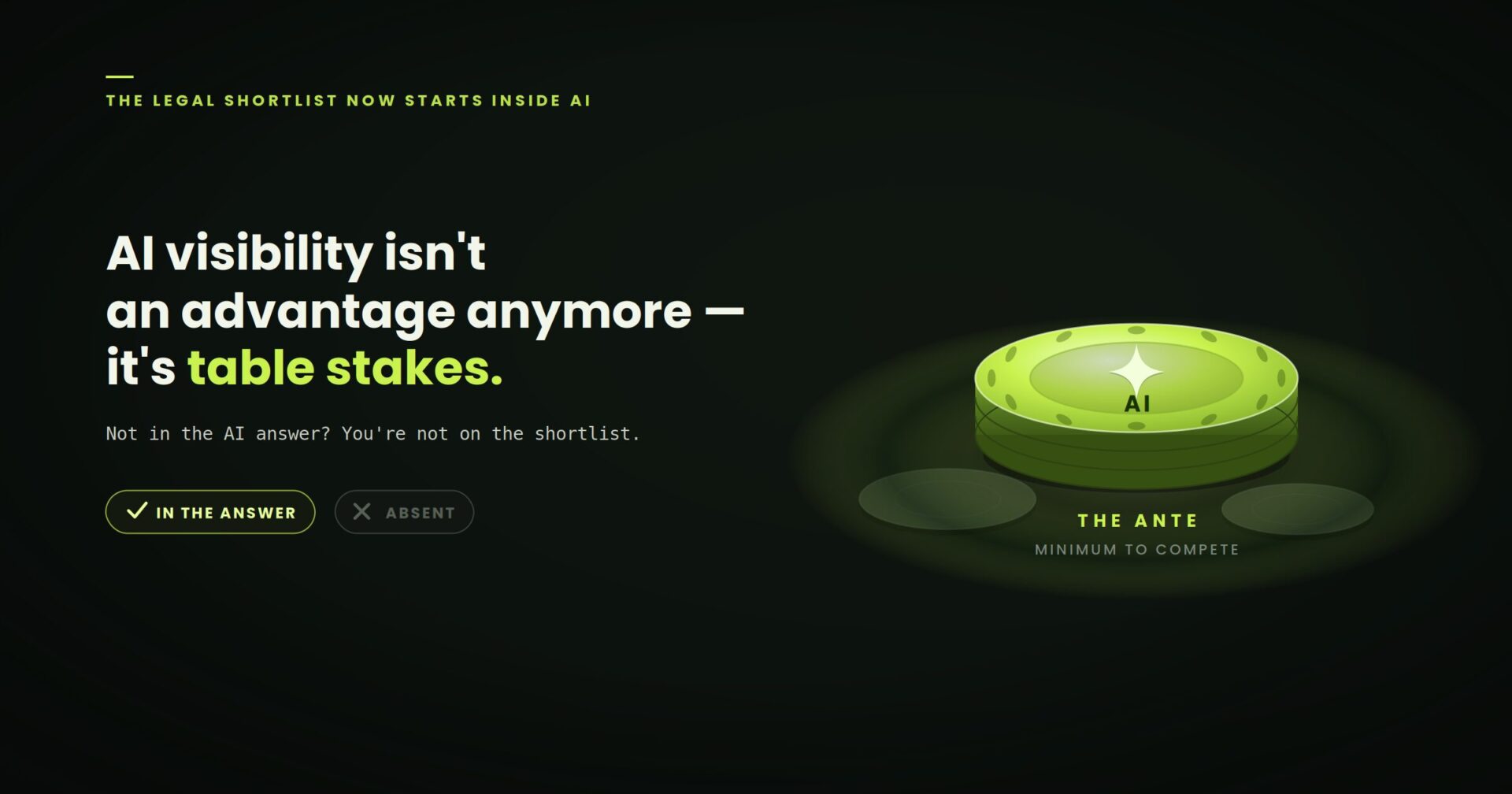
Make no mistake: this is table stakes now
I want to be direct about one thing, because I think it’s where firms most often miscalculate. None of this is a competitive advantage anymore. It is the price of admission.
A year ago, a firm that took AI visibility seriously was ahead of the curve. Today, a firm that ignores it is simply absent – not lagging on some optional, nice-to-have channel, but missing from the conversation where buyers form their shortlist. The competitive edge has already moved on to not just doing this, but how well you do it. The baseline expectation is that you do it at all.
Firms that are still debating whether AI changes their marketing and media strategy are debating a question the market settled while they weren’t looking. The ones who built their authority early are already being cited; everyone else is starting the race a lap behind, and the gap compounds every day the work goes undone.